Atomica
How it works

How an F1 car works

An F1 car is physics turned up to maximum. Seven moving models show why it corners at 5 g, brakes from 320 km/h in two seconds, and could in theory drive upside down.
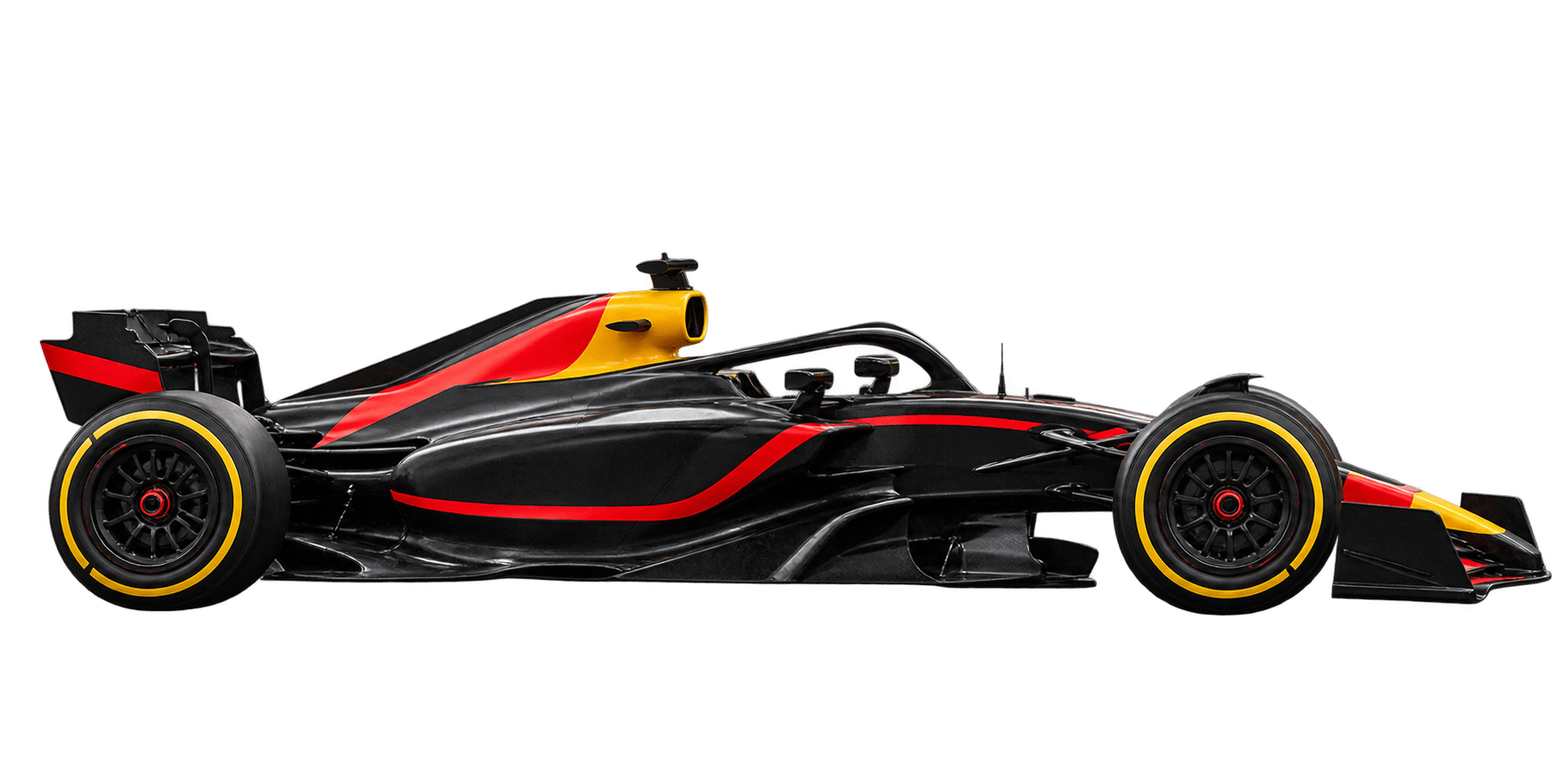
Formula 1 car, side view
Part 1

Downforce: wings that push down

An aeroplane's wings lift it up. An F1 car's wings are the other way round. They use the rushing air to press the car onto the road, and the faster it goes, the harder they press.

front wing pushes down 4 kNrear wing pushes down 6 kNweight 8 kNThe wings are upside-down aeroplanewings. Air rushing over them pushesthe car DOWN onto the road instead oflifting it up.Downforce is 1.2× the car's weight. Intheory it could drive on the ceiling!
Downforce grows with speed squared: double the speed, four times the push. That is why an F1 car grips so much better in a fast corner than a slow one.
Speed:Wing angle:
Downforce9.3 kN
Car weight7.8 kN
Total push onto road17.1 kN
Could drive upside down above184 km/h
Part 2

Cornering at 5 g

Every corner needs a sideways push from the tyres. An F1 car has very sticky tyres, and downforce presses them down even harder, so it can take the same corner far faster than any road car.

sideways push from the tyresSame corner, radius 60 m. The F1 car can take it at127 km/h (2.1 g). A road car manages about 83 km/h(0.9 g).Two reasons: sticky slick tyres grip almost twice aswell, and downforce presses the car onto the roadharder the faster it goes.Red: F1 carBlue: road car
Cornering needs a sideways push of speed² ÷ radius. Tyres provide it through friction, and friction grows when the car is pressed down harder. Downforce is like adding weight for grip without adding weight to accelerate.
Corner radius:
F1 max speed127 km/h
F1 sideways g2.1 g
Road car max speed83 km/h
Road car sideways g0.9 g
Part 3

Air drag, DRS and slipstream

A wind tunnel with smoke lines shows how the air flows over the car. Watch the rear wing throw the air upwards, then open DRS and see the smoke slip straight through. Less drag means more top speed.

air rushing past at 337 km/hwing throws air upwardsso the wing is pushed downdrag 6.8 kNDRS closed: the smoke shows the rear wingbending the air sharply upwards. Pushingair up pushes the wing down (downforce),but blocking the air costs drag.A wind tunnel blows air past a still carwith smoke lines so engineers can see theflow. Same as driving through still air.Top speed: 337 km/h
DRS means Drag Reduction System. A driver within one second of the car ahead may press a button on certain straights. A flap in the rear wing opens, drag drops, and overtaking becomes possible. It closes again as soon as the driver brakes. Top speed is reached when the engine's push equals the air's drag, so cutting drag means more speed.
Top speed337 km/h
Air drag at top speed6.8 kN
Engine power640 kW
Drag area1.30 m²
Part 4

Braking from 320 km/h

Slide the brake up. Carbon brake discs glow red hot as they turn a huge amount of motion energy into heat in about two seconds. Compare the F1 car with a road car doing the same.

0 m100 m200 m300 mF1 car: 320 km/hRoad car: 320 km/hSlide the brake up. An F1 driver pushes thepedal with more than 100 kg of force.Downforce helps braking too: at high speedthe tyres are pressed down harder, so theycan slow the car at up to 5 or 6 g.
At 320 km/h an F1 car carries huge kinetic energy. Braking turns nearly all of it into heat in the discs in about two seconds. The driver feels 5 g, like their body weighing five times more.
F1 speed320 km/h
Slowing down0.0 g
Distance used0 m
Disc temperature400 °C
Part 5

The hybrid power unit

A small 1.6-litre turbo engine plus a powerful electric motor. The motor charges its battery every time the driver brakes, then adds its push on the straights.

Turbo V6 engine1.6 litres, 400 kWMGU-Kmotor + generatorBattery 60%To the rear wheelsengine 400 kWmotor adds 350 kWelectricity outOn the straight the driver deploys: the battery feedsthe MGU-K motor, which adds up to 350 kW to theengine's 400 kW.From 2026 the electric motor makes almost half thepower, and the old MGU-H turbo generator is gone. Thefuel is fully sustainable.
An F1 power unit is a hybrid: a small turbo petrol engine plus a powerful electric motor. Together they make about 750 kW, close to 1,000 horsepower, from just 1.6 litres.
Engine400 kW
Electric motor+350 kW
Total to wheels750 kW
Battery60%
Part 6

Tyres: grip that wears away

Soft rubber grips best but wears fastest. Watch the grip fade lap by lap for each compound, and see why tyres must be hot to work.

Laps →GripTyre 60 °Cas laps go by, the rubber wearsFresh tyres: full grip once they arewarm.Tyres at 60 °C: too cold to grip well.Drivers weave to warm them.Soft: most grip, wears fastestMedium: in betweenHard: least grip, lasts longest
Soft rubber grips better because it moulds into the road's tiny bumps, but it wears away faster. Teams choose which tyre to start on and when to stop for new ones. That choice can win or lose a race.
Lap0
Grip left100%
Lap time85.2 s
Tyre temperature60 °C
Part 7

What the driver feels

In a fast corner the driver's head and helmet feel five times heavier. Pick a situation and see the force the neck must hold.

head pulled sideways: 343 N5 g means every part of the driver feels 5times heavier than normal. A 7 kg head andhelmet feel like 35 kg.For comparison: a roller coaster givesabout 3–4 g, a fighter pilot can take 9 gwith a special suit, and you feel 1 gright now.Drivers train their neck muscles for years and use aHANS device that stops the head snapping forward ina crash.
g-force is not a new force. It is just how strongly the car pushes on the driver to change their speed or direction. The faster the change, the bigger the push, measured in multiples of gravity.
Force on the driver5 g
Head feels like35 kg
Neck must hold343 N
Directionsideways

Physics wins races

Downforce, friction, energy, power and heat: every tenth of a second in F1 comes from using these ideas better than the other teams.

See how a normal car works